
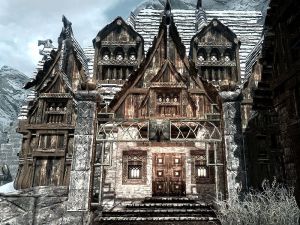
I like good stories in video games… and vivid characters, and all those rich goodies that make me feel like video games are the equivalent of films and books in making artistic statements and providing emotional impact. For all its size and beauty, Elder Scrolls: Skyrim has pretty much none of these.
But last week I started a new playthrough of Skyrim, after not touching it for about 6 months. And I have to admit: I’m sort of addicted. (But please, I say that lightheardly and don’t mean to get into the deep dirty waters of “video game addiction!”) Diving into the open-world sandbox of Skyrim after months of puzzle games and linear stories like Portal 2, Alan Wake and the Mass Effect series makes me realize just how easily the desire to level up can turn into something like a mild obsession.
To Skyrim‘s credit, it doesn’t have to be the level grinding experience that some games fate their players to face. Sure, it’s possible to aimlessly explore Skyrim, clearing out cave after cave after cave… But for players like me, it’s much more fun and reasonable to level up by joining factions and following their quest lines, all of which have slightly entertaining stories.
Still, when I play a linear game like Mass Effect, I don’t think much about leveling up. I just think about the quest I’m on, how to beat this particular enemy, what my squad mates are doing and what the next cutscene will reward me with story-wise. I’m engaged in the storytelling but not obsessed by the game. The most recent game I played that I could barely put down was Mass Effect 2, which I whizzed through during a week off from work. I was a total hermit for the week I played it, and I enjoyed every minute of it. But being really into playing a linear game feels much lighter than the obsessive need to level up that some sandbox games provide. Playing Skyrim again is a whole different experience than playing Mass Effect 2.
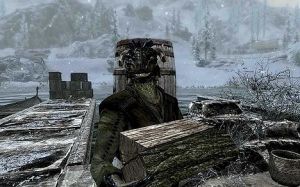
With Skyrim, I’m constantly thinking of how many items to disenchant before I level up, how many quests I have until I receive the Nightingale armor, where I can set skeletons on fire for J’zargo… It’s all about leveling, getting better gear, gaining a more skilled follower and completing quest lines. It’s all calculations. And it’s not necessarily a bad thing, as these are role-playing elements and very much about game mechanics, which is what RPGs are all about, really.
Still, I don’t feel like Skyrim offers the depth of some linear games I’ve played. There are few real consequences for your in-game actions, other than becoming Archmage or gaining the ability to purchase a house from the jarl. Which means that my interest in the game is all about leveling. Which means that, although I’m typically much more satisfied playing a story-oriented, linear RPG like Dragon Age: Origins, sandbox games offer gameplay that’s much more compulsive, if not quite as diverting.
An Escapist magazine article highlights the way game designers use “compulsive gameplay” to keep players attached to their games, with one example — the one I experience most — being the compulsion loop. It aims to give players “a never-ending sequence of new content and goals,” as SixToStart game designer Adrian Hon says. It’s meant to be addicting in a fun way. (And I can confirm that it definitely works!)
When I played Dragon Age: Origins, the story was so epic that I actually wanted to save quests for later, when I could better savor them. With Skyrim, I’m much more apt to say, “Just one more quest”… until another hour has passed without me putting down the controller.
Maybe it’s just me. But I’m finding sandbox games much easier to stay glued to than most linear games… and I’m not even a sandbox game type of person.
— Ashley


 ROBOHEARTBEAT
Leave a comment