
For the past several months I have been reading The Stolen Throne, a novel that relates events that happened decades before the start of the video game Dragon Age: Origins. It’s written by David Gaider, lead writer of the Dragon Age game series — so I knew it was going to be good. Or at least good-ish. But after reading Drew Karpyshyn’s Mass Effect: Revelation novel (you can read my review here), I wasn’t expecting stellar writing as much as I crossed my fingers for a light, entertaining story in one of my favorite BioWare worlds.
The Stolen Throne has totally exceeded my expectations.
The novel tells the story of Prince Maric and a young, gruff outlaw named Loghain (yep, the villain of DA:O!), who are thrown together at the start of the novel. A usurper has killed the Rebel Queen, who is Maric’s mother — and that means Maric is suddenly the leader of those loyal to the true royals of Ferelden. He and Loghain start off on the run from the usurper, but their ultimate goal is to unite the rebel army and defeat the usurper so Maric can take his true place as Ferelden’s king. And then a traitor enters their group…
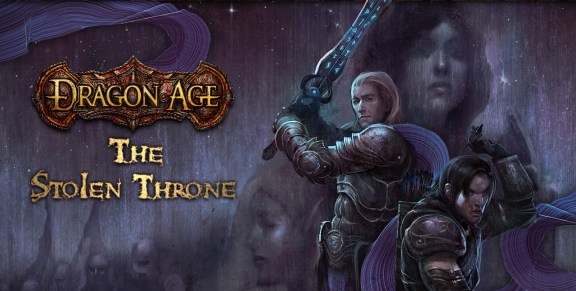
The first thing that stood out to me was the amazing prose. I hope David Gaider continues to write novels, because I’ve decided that I will read anything this man writes. I know it’s a different author and a different series, but comparing this novel to Mass Effect: Revelation, this one felt like a rich novel for any reader — not just a video game book. The prose keeps the action clipping along at a fast pace, but it also takes enough time to set the scene in interesting ways. Gaider’s world-building in this novel is amazing, so you’ll still understand this fantasy world even if you haven’t played the Dragon Age games yet.
The fight scenes also show off Gaider’s skill as a writer, because while most fight scenes drag for me, these are actually exciting. Battles are where it’s at in The Stolen Throne. Many descriptions seem to slow down time so readers can focus on details of what was happening, such as seeing the gleam of a sword hitting the ground dangerously close to Maric’s head. I’ve always believed that you can only feel something is epic if you see and fall in love with the tiniest details, and The Stolen Throne’s fight scenes manage to balance that perfectly — the big action as well as the intricacies.
But the novel’s greatest strengths is its characterization. Maric is charming, funny, and unsure of himself as a leader. He reminded me of what a young Alistair would be like; I guess that wacky, self-deprecating humor (Maric: “I fall off horses. It’s this thing I do.”) must run in the family. Maric is also betrothed to Rowan, a woman who is much wiser and more confident than he is — and she’s skilled in battle, too. Watching their relationship is highly entertaining and realistic. Because they grew up together, they tease each other almost as siblings would, yet Rowan is clearly in love with Maric. Unfortunately for her, the engagement is more of an obligation to Maric at first.
This opens up a love triangle with Loghain, who is the most riveting character in the book. Sure, he’s villainous in Dragon Age: Origins, but no so in The Stolen Throne. Here, he’s one of Maric’s most trustworthy friends and a loyal fighter at his side. He’s tough. He’s a fighter. He can seem gruff at times and is often impatient with Maric. But you get to see so many other sides of his personality, and his wisdom both on and off the battlefield make him a character I rooted for throughout the book — even when some of his actions are morally questionable.
The Stolen Throne also gives insight into Loghain’s past. Early in the book, you watch as his town is destroyed and his father killed. It’s a tragic origin story that makes him a relatable character and, if you go on to play DA:O afterwards, a well-rounded villain who has had his share of sorrow like anyone else.
That being said, he makes decisions that may make you hate him even more as a character by the end of the book. He believes he’s working for the greater good, but it’s up to readers to decide whether they’ll forgive him or not. Really, if you’re at all interested in learning more about the characters of Dragon Age, this is a very deep character study on Loghain.
The book’s biggest weakness is its stop-and-go pacing. It’s 400 pages — not really long or short for a novel these days — but it crams in a little too much. When it focuses on the characters’ relationships, conversations, fight scenes, betrayals, and all of that wonderful conflict, it’s a smashing good read… but it falters under the weight of tedious, descriptive scenes that skim over several weeks at a time to get to the next good part. The awkward pacing doesn’t ruin the story at all, but it weakens the book if you’re looking for a breezy read.
Bottom Line: If you read The Stolen Throne, you can expect a well-developed fantasy world, lots of fighting and politics, and a little bit of magic. Also, darkspawn. This is the perfect novel to get you through the next several months of waiting for the release of Dragon Age Inquisition. But I would recommend this book to more than just Dragon Age fans: I believe it’s an all-around fantastic novel for any fan of fantasy books.
— Ashley


 ROBOHEARTBEAT
Leave a comment