
When I’m looking for a new nerdy obsession, I typically gravitate towards science fiction more than fantasy. It’s a very slight bias, because I love both… but when I’m immersed in a science fiction world, I feel a certain awe for what humans could potentially accomplish. I also hold science fiction authors in great esteem, because science fiction requires all the creativity and intelligence it takes to write fantasy — and then it requires scientific knowledge on top of all that. After all, part of the appeal of (most) sci-fi is the futuristic technology.
So what happens when you read science fiction that doesn’t come true? Watching Star Trek: Deep Space Nine recently, the two-part episode called “Past Tense” has the crew of the Defiant visiting San Francisco circa 2024. The social commentary is incredibly interesting; during this time, the city has a “Sanctuary District” that houses the homeless. As you can probably imagine, this supposedly altruistic scheme has failed to create an idyllic place for people who are essentially treated as society’s outcasts; their freedom is taken away, and life inside this ghetto is hardly superior to what life might be like out on the streets.
The problem with the episode is the technology. Terminals are bulky — not the flat-screens we know today. At one point, Dax visits the office of a wealthy, famous entrepreneur and uses his computer, which turns out to be one of those bulky white desktop computers commonly seen in… well, the 1990’s, when DS9 was on the air.
These types of things crop up all over the Star Trek universe, as well as many other sci-fi worlds, but they feel more comfortable when they’re part of a distant, fictional future that has its own rules. It’s not so bad to see someone use a ridiculous walkie-talkie device if it’s on a spacecraft that’s using cloaking technology. Somehow, the mind-blowing technology balances out the technology that just sort of fizzles, and it all works together to feel authentic. However, seeing these characters jump back to a time that’s so close to our own puts all of the anachronisms into glaring focus.
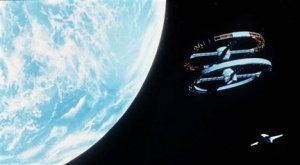
This doesn’t ruin my enjoyment of science fiction. I don’t hold these sorts of “future anachronisms” against world-builders or writers. How can anyone be expected to predict exactly what technology will look like in the future, and exactly when it will look like that? And sometimes the date doesn’t even matter, such as in 2001: A Space Odyssey. So what if we don’t have a moon base yet? The film loses almost none of its ability to inspire awe on the part of the viewer, even if the date 2001 no longer screams “space age!”

But there’s no denying that it’s a jarring experience to see a futuristic world depicted in such an old-fashioned way. On the positive side, in a lot of sci-fi from the 20th century we see handheld data pads, video chatting, and remote communication devices that are arguably a step up from the cell phone. However, there’s also a distinct lack of personal computers and internet, because they’re examples of the technological advances that are so revolutionary and hit with such lightning speed, nobody could predict how much they would change how we go about our daily lives.
This is what terrifies me about writing science fiction of my own. I don’t want to create a world and completely miss a game-changer like social networking. Similarly, I don’t want to be overly optimistic and assume that we’re going to unlock faster-than-light travel within a couple of decades.
In today’s ever-changing world of fads and innovations, it seems the safest science fiction to tackle is space opera. In the 21st century, we’re space opera junkies. The further we are from developing a type of technology in the real world, the safer we are in imagining it for a fictional world. Sometimes that even translates to awe and anticipation for what the universe’s future really holds.
— Ashley


 ROBOHEARTBEAT
Leave a comment