
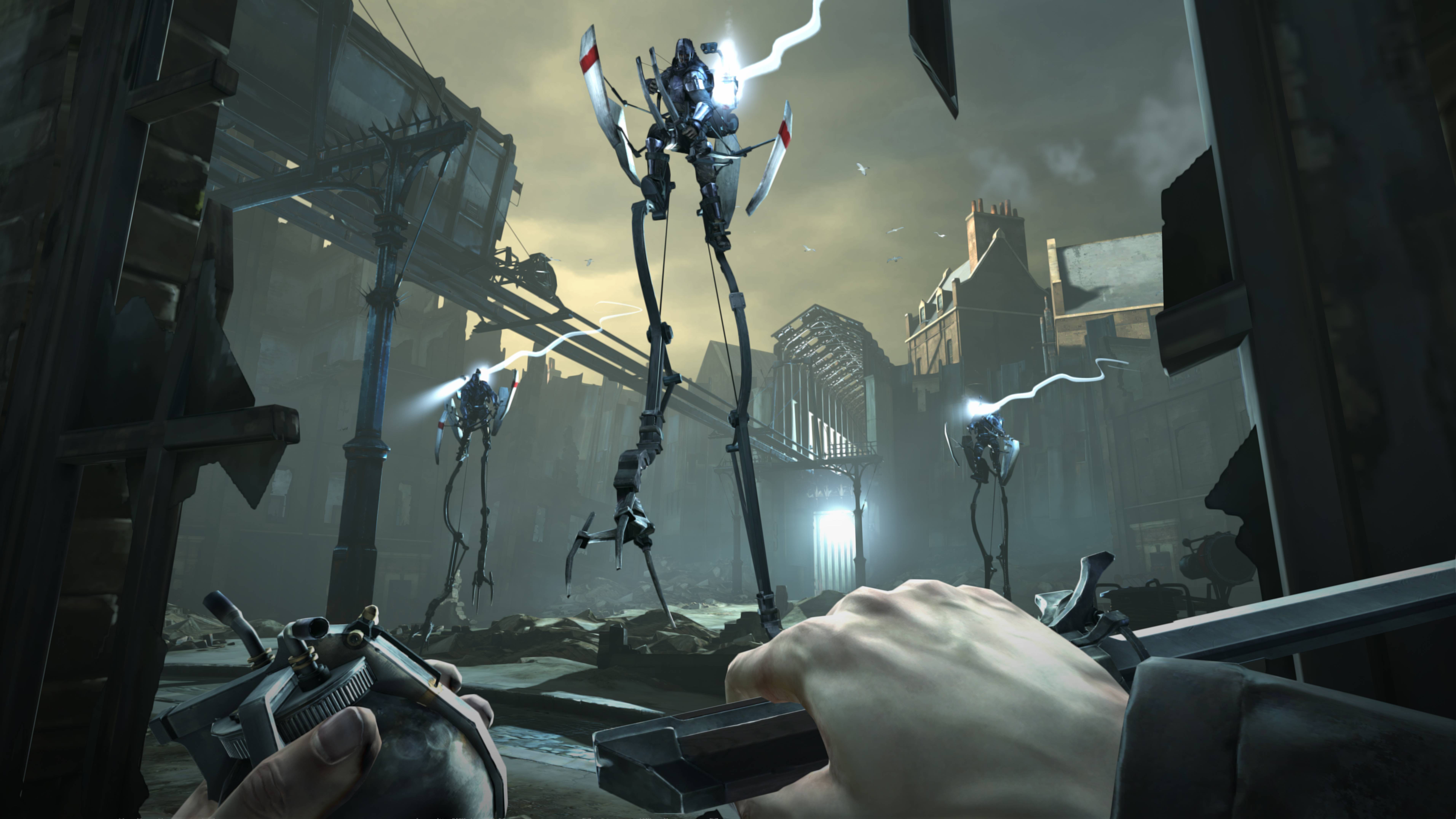
The past couple of weeks, I replayed the video game Dishonored (on Xbox One, this time). With the sequel coming out later this year, I wanted to remind myself of the game’s story and style.
Dishonored is a stealth game. You step into the boots of a supernatural assassin named Corvo — though that’s not really a fair term, as you can play the whole game without killing anyone. The setting is a steampunk-like city called Dunwall, and since most missions require some sneakiness, you spend most of your time there in the night hours.
First let me say that I am not very experienced with stealth games. I also lack patience. What attracts me to Dishonored is not so much the stealth as the supernatural powers that Corvo acquires toward the beginning of the story. And while at its heart, Dishonored is a game that rewards stealth and non-lethal approaches, you can get through the game in a very exciting way if you make generous use of Corvo’s powers instead.
 Corvo’s supernatural arsenal includes tricks like teleporting, stopping time, seeing through walls, possessing animals or people, and summoning a pack of rats to nibble at enemies. You have to unlock these abilities with runes, which are found around the environments in missions or purchased from Corvo’s weapon outfitter. It took me over half the game to unlock all of the powers, but if you are more thorough about scouring every mission for collectibles, you’ll find a lot more runes than I did and should be able to unlock (and even upgrade) everything in the first levels.
In my case, I felt like I really mastered Corvo’s abilities in the final mission of the game. I was happy to finish the game but also sad that my playtime was over, just when it was getting good.
That’s because testing out Corvo’s powers can be as terrifying as it is thrilling. With curfews at night, the streets of Dunwall seem to house just two groups of living things: rats and guards. And those guards are very good at their jobs. Stealth comes in handy, but it requires so much care that trying a new power — which can be pretty clumsy — risks guards spotting you and alarms going off all over the area.
 Maybe that’s why I didn’t get fully acquainted with Corvo’s supernatural arsenal until late in the game. Or maybe I just wasn’t thinking in a creative way at first. Either way, once I got the hang of these abilities, Dishonored went from being a game where I tip-toed around, saved my game every two minutes, and reloaded when spotted by guards (which was often)… to being a game where I had the freedom to dart around like a magic ninja.
Here’s an example. In the final mission, I climbed a staircase and, using Corvo’s Dark Vision to see through walls, spotted a band of three guards hanging out on a balcony, right where I needed to get by.
Without overthinking it, I summoned rats to start devouring them. This doesn’t kill the guards, but it is an excellent distraction. I was able to shoot one of them with Corvo’s crossbow, but due either to the difficulty or my poor aim, it took a couple of shots. That’s why having the rats there came in handy; the guard was so busy freaking out about them that he didn’t even register me, let alone try to fight back.
Still, three guards is a lot of guards, and summoning one swarm of rats only distracts about one or two at a time. The third guard shot at the rats to try to help his pals, but by the time I was shooting my crossbow at the first guard, he prioritized Corvo as his new target.
Some guards have swords; others wield pistols, so they can hit you from range. This one had a pistol.
Since there was no getting to him before he shot me, I stopped time, teleported Corvo over to him, and killed him with a knife in a single swipe. I then took my sword to the other two guards, before the rats left and before time returned to its normal speed.
It was a quick, painless experience. It wasn’t stealthy or subtle, and it certainly didn’t win me the Clean Hands achievement for a non-lethal playthrough — but it was fun.
Now, Corvo has a limited supply of things like pistol bullets, crossbow bolts, sleep darts, and spiritual remedies that replenish his mana so he can use his powers. That means that taking this kind of approach all the time is very wasteful. Stopping time drains almost an entire supply of mana, and since you can only carry around up to 10 refills at a time — maybe finding an extra two or three in the environment during any given mission — you can’t use this every time you spot a guard. Trust me, there are a lot more than 10 in a level.
Being sneaky is what Dishonored rewards, yet it gives you this set of versatile tools that, for me, worked better in a playthrough with killing. Sure, in favor of stealth… stopping time can give you precious moments to find a hiding spot away from enemies, if you don’t want to kill them. Summoning rats can be a good distraction, as long as you’re extremely quick at sneaking away. And Possession is perfect for taking control of a guard and walking right through a gate, provided you know where to escape to as soon as it ends. However, it’s so easy to alert the guards — of whom they are just so many — and so challenging to hide that I found these powers more useful if I was planning to attack their targets, not run away from them.
 A total stealth, non-lethal Dishonored game is one way to play — a specific kind of challenge that requires a specific kind of skill. However, I enjoyed mastering Corvo’s powers in this type of playthrough. It caused the world to be dark, rats to be everywhere, and a sad ending. (That’s what happens in Dishonored if you kill a lot.) But playing Covo as a no-qualms badass was so satisfying to me.
— Ashley


Leave a Reply to What’s New — June 2016 | Robo♥beatCancel reply