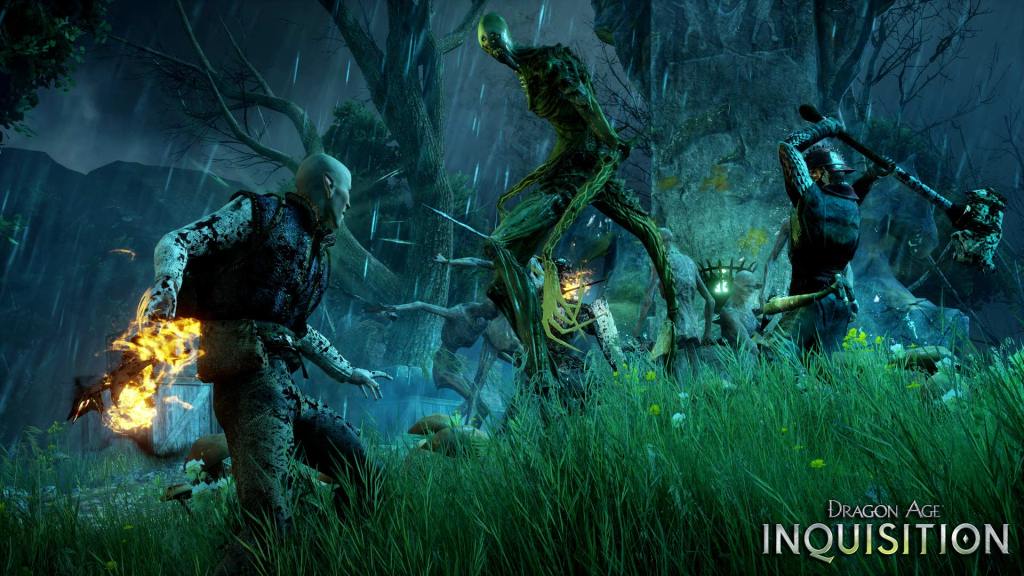
Lately I’ve jumped back into Dragon Age: Inquisition. What’s weird is that I find the combat less interesting than it was in previous Dragon Age games, and I’m not entirely sure why. That’s why I’ve decided to break down how fighting works in each game!
Dragon Age: Origins (2009)
 In the first game, playing on PC is the way to go. This is because the game feels very tactical. You can play on the Casual difficulty and just target enemies to throw hits at them, one after another — but that’s not the most fun way to play. It’s the easy way to play, and it’s arguably the best way to play on console since it’s harder to target tactically when you can’t pan around with your mouse. But it’s not the most fun.
To really enjoy Origins’ combat, you have to pause battles and peer down at them from above. This is the overhead tactical view I love. From here, you can select any of your playable characters, target an enemy, and choose which attack you would like to perform. Since you can control a party of four characters, this gets pretty fun. For instance, you can have your mage freeze an enemy, then swoop in with your warrior to shatter the ice sculpture you have just made. You can also issue other commands to your team, making sure everybody gets a health potion when they need one and using spells that boost your own party’s skills.
I didn’t always use a lot of strategy when I played Origins. I also have never completed the game on the hardest difficulty. But having played the game multiple times, I can tell you I’ve tried it all — on both PC and console — and playing at least parts of battles tactically on PC is the richest experience to me.
Dragon Age 2 (2011)
 Dragon Age 2 feels much more streamlined than Origins. You can tell there’s been a major jump forward in graphics and a seamless experience now that a couple of years have passed.
But for anyone who enjoyed the tactics, like me, the more streamlined style is a detriment. It came as a surprise to me, as everything from issuing commands to actually enacting them clipped along at a very fast pace. I liked the fluidity of the fighting, but I worried about precision. Besides that, tactics seemed to go out the window, as the best way to play 2 is to just turn on a low or medium difficulty and stick to your main character, fighting enemies in real time.
In some ways, Dragon Age 2’s combat feels much more like a modern fantasy game, in the same vein as The Witcher, Skyrim, Fables, or even some hack-n-slash games. The problem? Its speed didn’t make up for the fact that all you had to do was push buttons. There’s no major aiming in Dragon Age, so you can essentially just hold down your attack button until your abilities recharge, then hit enemies with some special skill and go back to your base attack for awhile. That’s a little yawn-inducing to me.
Playing as a mage helped here, as I enjoyed picking my skills. I focused on winter spells and crowd control. The diversity makes things much more interesting than they are when you play as, say, an archer who just shoots arrows over and over. (Archery just didn’t do it for me in Dragon Age 2.)
Dragon Age: Inquisition (2014)
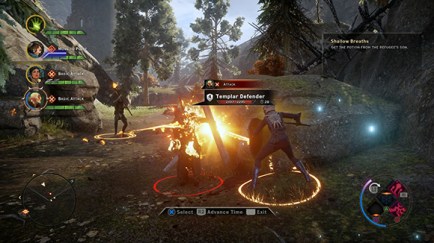
Top-down tactics is back in Dragon Age: Inquisition, but it plays a little differently than in Origins. In Inquisition, you can press the View button (Xbox One) to pause any battle, and then select your party members to issue commands to them. That’s like Origins.
However, now you hold a trigger button on your controller to go to real-time action, which basically shows your characters running around the battlefield doing exactly what you just told them to do. As soon as you release the trigger button, they freeze in place, waiting for your next command. (Unless they’re not done with their latest actions. Then they’re waiting for you to hold the button again so they can keep moving.)
This sort of tactical combat is easy to grasp, but I don’t find myself using it all that much. Like Dragon Age 2, the combat is very streamlined and fast-paced, and playing on console makes that approach feel much more polished than trying to maneuver the frozen battlefield with the left stick. Besides, I don’t have so much trouble in battles that I feel like I need to set up a chain of attacks between characters the way I did in Origins. I mainly use it when one of my party members falls in battle, and I need to locate them on the field so my mage can go revive them.
I’m glad that Inquisition brought back the overhead tactical view, but it still doesn’t quite work for me on console. Maybe if I play on PC someday, I’ll put it to better use.
Setting Up Tactics for Party Members
On a side note, Inquisition has done away with a lot of the detailed Tactics you can set up for your party members. Basically, there’s a menu where you can set up behaviors for these characters to help manage them on the battlefield when you’re not actively controlling them. For instance, you might decide that a character automatically uses a health potion when their health declines to 20 percent.
In Origins, you could do all kinds of things, like tell your mage friend Morrigan to use an area of effect spell whenever three enemies or more were clustered together in a group; if there were only two enemies together, you could set her up to do something else. It was very detailed like that.
Unfortunately, Inquisition just lets you manage health potions and skills in a very general way, so you can’t use tactical strategy on a secondary level anymore — you have to actually jump into that character’s skin in the middle of a battle to tell them which attack to use at any given time.
Conclusion
Of the three Dragon Age games, I feel that Inquisition offers the most variety to players. Go full-speed or plan some strategy — the choice is yours. But Origins created such a rewarding tactical combat system that it remains my personal favorite to play.
— Ashley


 Robo♥beat
Leave a reply to Ashley Hagood Cancel reply