
I didn’t grow up reading comics. I didn’t know much about superheroes. My biggest introduction to any superhero was in Sam Raimi’s Spiderman films, which came out when I was a teenager. His Spider-Man 2 is still one of my favorite superhero movies; I watch it all the time. Then came Christopher Nolan’s Batman series; Batman Begins is another of the greats for me. While other superhero movies are brash and entertaining in theaters, these two series feel rewatchable because they are so character-driven. They focus on that inner conflict heroes face when they lead normal lives by day and fight crime at night. Leading a double life — and then not being able to tell anyone about it — is a tough gig.

Thor was one of the flock of “other” superheroes who passed me by. I barely knew the character existed until the 2011 movie came out. The films reveal a fun mix of Norse mythology and science, as the god Thor leaves Asgard for Earth and falls in love with an astrophysicist, and all that made me want to learn more about the comic book character. After some research, it seemed the best place to start was with Walter Simonson’s legendary run of the series back in the 1980’s.
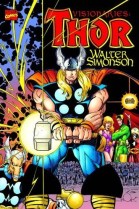 This run stirs up all sorts of elements in a perfect blend. There’s humor, as when Asgardians take leave in New York City and marvel at the cookware in the “meadhall” called Macy’s Department Store. There are quiet moments of Thor maturing, such as when he recovers from injuries and grief as his grandfather’s home. There are subplots with love potions, Loki’s scheming, and the great Asgardian hero Balder. There are epic fights; the biggest I’ve read so far has been a showdown between the the Asgardians and the Frost Giants in New York, a battle commanded by the honorable alien Beta Ray Bill. And through all of this action, there’s the mysterious threat of a fiery enemy forging a great weapon, the word “DOOM” threatening the reader with what’s to come.
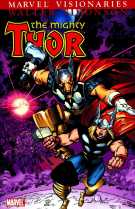 Walter Simonson’s run is collected in five volumes called Thor Visionaries. I’m currently reading the third volume, so I have yet to see things like Thor turning into the Frog of Thunder. (I can’t wait for that.) But already I love this run and highly recommend it to anyone wanting to explore Thor’s mythology for the first time.
In vol. 1, the greatest story is Thor meeting Beta Ray Bill. His story is the first in Simonson’s run, so really my initial introduction to Thor comics was all about Bill. The story begins when S.H.I.E.L.D. asks Thor to investigate an alien ship, which he believes to be a warship on inspection. But Beta Ray Bill, a horse-like alien, is guarding the ship from inside. He and Thor have a fierce battle over it.
On its own, this isn’t all that interesting — until Bill picks up Thor’s hammer, Mjolnir. This just hasn’t happened before. Only those worthy to wield the power of Thor can pick up the hammer, and the fact that Bill wields it instantly elevates him to more than some forgettable alien villain.
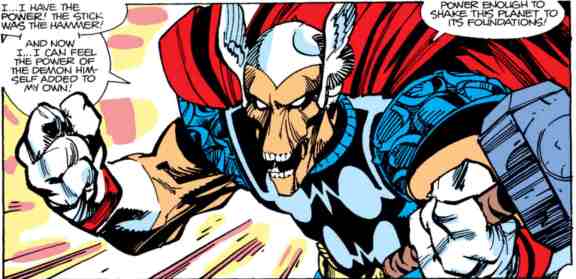
After Bill beats Thor, he is able to journey to Asgard and tell his story. It turns out Bill’s race, the Korbinites, is nearly extinct, and the last of his people are inside a fleet of warships. It’s Bill’s job to protect them, along with his sentient ship Skuttlebutt. The reason for Bill’s appearance is a scientific process that gave him the abilities of a wild beast, making him better able to protect his people.
Odin decides that Thor and Bill should battle for Mjolnir. During the battle, Bill is able to scrape to a win over Thor, but he chooses not to kill Thor. Impressed, Odin decides to forge Bill his very own weapon, called Stormbreaker; it has the same powers as Thor’s hammer. From then on, Beta Ray Bill can strike Stormbreaker on the ground to return to his original Korbinite form. On top of all that, Sif — my favorite character in the series, a mighty warrior and Thor’s old flame — falls in love with Bill and decides to accompany him when he leaves Asgard.
Beta Ray Bill makes other appearances in the series, joining the Asgardians when they need aid. In fact, the second volume of Thor Visionaries shows his most epic return in the Asgardians’ fight against Frost Giants. Thor is needed in Asgard, so he names Beta Ray Bill commander of the Asgardian forces fighting in New York. After all, with Stormbreaker, Bill has all the powers of Thor, and he has already deemed himself an honorable friend of Asgard. The warriors who don’t know Bill are quick to judge him as an outsider, but Bill wins them all over in the end. There’s one interesting moment when the Asgardian warriors want to rush to attack an overwhelming enemy force, but Bill chooses a careful infiltration instead. It’s not exactly the Asgardian way to sneak around the back, but Bill’s intelligence wins the battle.
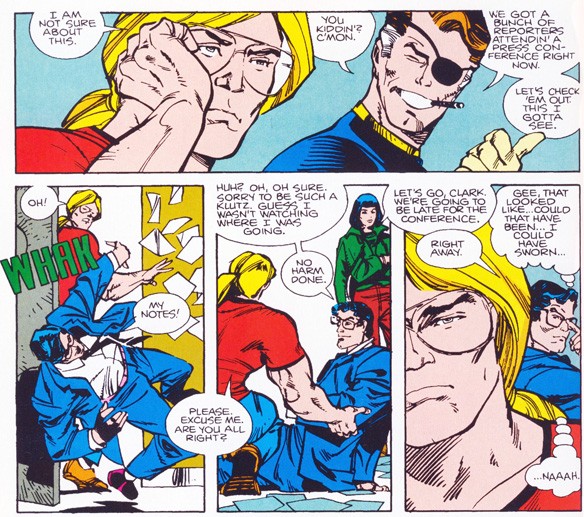
I also love Thor Visionaries for its small moments. For instance, early in Simonson’s run is a brief nod to Superman. First, Thor takes human form and adopts glasses for his new secret identity: a construction worker called Sigurd Jarlson. But the spectacles aren’t enough — he actually has to bump into Superman:
The first volumes also contain quite a few heroic moments that shed light on Norse mythology. You can tell Simonson loves the legends surrounding Thor and what Asgardian culture would be like. For instance, there’s a brief story involving Thor meeting a very old, weakened warrior whose only wish is to die in battle so he can go to Valhalla. And so Thor takes him to battle in New York against the dragon Fafnir, during which the old warrior gathers all his strength to save Thor’s life and dies a hero. It’s a small, moving moment, and in many ways forgettable — but these are the little touches that give this run of Thor so much depth.
To be honest, Thor shouldn’t be my favorite superhero. I like superheroes who struggle with their secret identities, who do good deeds with no attention or reward for their everyday selves. I love Captain America for being someone who spent his life weak and beat up, and because of those experiences understands humility after he gains superpowers. Thor, an impatient royal and a warrior who wields a magical weapon that gives him incredible power, isn’t the easiest to relate to at first glance.
But Simonson’s run of Thor seems to highlight all of the attributes that make this superhero feel so human. He’s courageous, but he also has moments of weakness. He whines. He grieves. Other times, he’s gracious even when he doesn’t get what he wants. He loses people he loves, he helps others, he has to make difficult choices when others’ lives are at stake. These are all things to which we can relate as people, and they’re what make Thor so lovable in the long run.
— Ashley


 ROBOHEARTBEAT
Leave a comment